Weather Alert in Idaho
Avalanche Warning issued February 24 at 7:58PM MST by NWS Pocatello ID
AREAS AFFECTED: Caribou Range; Big Hole Mountains
DESCRIPTION: AVWPIH * WHAT...Avalanche warning. The avalanche danger is high due to heavy rates of snowfall and intense wind. * WHERE...The mountains of southeast Idaho including the Snake River Range, Caribou Range, and Big Holes. The mountains of western Wyoming including the Tetons, Snake River, Salt River, and Wyoming ranges. * WHEN...In effect from Tuesday at 10 PM MST to Wednesday at 10 PM MST. * IMPACTS...Heavy snowfall combined with strong wind will create widespread areas of unstable snow and overload buried weak layers. Natural and human-triggered avalanches will be very likely across all aspects above 7,000 feet for backcountry recreationalists.
INSTRUCTION: Very dangerous avalanche conditions. Travel in avalanche terrain is not recommended. Gentle terrain below large avalanche paths could be impacted. Consult www.btavy.org or www.avalanche.org for more detailed information. Similar avalanche danger may exist at locations outside the coverage area of this or any avalanche center.
Want more detail? Get the Complete 7 Day and Night Detailed Forecast!
Current U.S. National Radar--Current
The Current National Weather Radar is shown below with a UTC Time (subtract 5 hours from UTC to get Eastern Time).

National Weather Forecast--Current
The Current National Weather Forecast and National Weather Map are shown below.

National Weather Forecast for Tomorrow
Tomorrow National Weather Forecast and Tomorrow National Weather Map are show below.

North America Water Vapor (Moisture)
This map shows recent moisture content over North America. Bright and colored areas show high moisture (ie, clouds); brown indicates very little moisture present; black indicates no moisture.

Weather Topic: What are Altocumulus Clouds?
Home - Education - Cloud Types - Altocumulus Clouds
 Next Topic: Altostratus Clouds
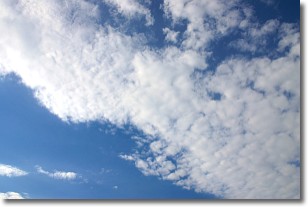
Similar to cirrocumulus clouds, altocumulus clouds are
characterized by cloud patches. They are distinguished by larger cloudlets
than cirrocumulus clouds but are still smaller than stratocumulus clouds.
Altocumulus clouds most commonly form in middle altitudes (between 2 and 5 km)
and may resemble, at times, the shape of a flying saucer.
These uncommon formations, called altocumulus lenticularis, are created by uplift
in the atmosphere and are most often seen in close proximity to mountains.
Next Topic: Altostratus Clouds
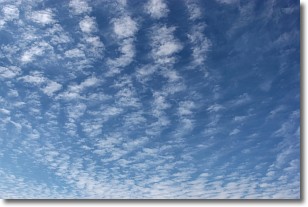
Weather Topic: What are Cirrocumulus Clouds?
Home - Education - Cloud Types - Cirrocumulus Clouds
 Next Topic: Cirrostratus Clouds
Cirrocumulus clouds form at high altitudes (usually around 5 km)
and have distinguishing characteristics displayed in a fine layer of
small cloud patches. These small cloud patches are sometimes referred to as
"cloudlets" in relation to the whole cloud formation.
Cirrocumulus clouds are formed from ice crystals and water droplets. Often, the
water droplets in the cloud freeze into ice crystals and the cloud becomes a
cirrostratus cloud. Because of this common occurrence, cirrocumulus cloud
formations generally pass rapidly.
Next Topic: Cirrostratus Clouds
Current conditions powered by WeatherAPI.com